I have a wonderful treat for you for Valentine's Day! It is my honor to offer a very informative guest post by the fabulous C. S. Lakin!
Enjoy her post and please be sure to read to the bottom as we're having a fun Give-Away!

Quick Tricks to Help
You Tighten Up Your Writing
Guest Blog Post
by C.
S. Lakin
Writers
often think about tightening their writing. Just what does that mean? And how
is it done? Is there a way that writers can tighten writing without losing
their voice or compromising their writing style?
Like sneaky
calories, many unwanted words and phrases find their way into our writing
unnoticed and bog it down. The goal should be to write in a concise fashion so
that our meaning is clearly understood. It’s not all that tricky to do. And
don’t worry—this can be done without adversely cramping a writer’s style.
That’s not
to say these tips are a cure-all for major flaws in a story, article, or book.
But similar to the get-in-shape-fast programs, here are some simple things
writers can do to tighten sentences, shed unwanted words, and tone and shape
the whole “body” of work.
1. Eliminate fatty words from your “diet.” Make a list of your weasel words. Those are the words
you throw in out of habit. Often they are pesky adverbs like very and just. Or phrases like began
to or started to. Grab a random page
of your document and see if you can eliminate at least one or two words from
every sentence. It may not be possible, but it’s a good exercise. If the word
doesn’t add importance to a sentence, it should go. Then attack the rest of
your novel.
2. Reword passive voice where possible. Whether referring to general passive (“The food was
eaten by me” instead of “I ate the food”) or present progressive passive (“The
food is being served” instead of “the waiters served the food”), most of the
time a sentence will be stronger if the passive voice is avoided. An easy way
to seek and destroy unwanted passive construction is do a “Find” for ing, was,
is, it was, and there was, to
name a few.
3. Avoid circumlocution. I just love that word, so I have to use it. Don’t use two words when one
will do. Don’t use four when three will do. If two adjectives are similar, pick
the best one and toss the other.
4. Ditch the extraneous speaker and narrative tags. If you are writing fiction or
narrative nonfiction, you may have dialog in your piece. Be aware that if the
reader knows who is speaking, you don’t need to tell them over and over—especially
in a scene with only two characters. And remove all those flowery verbs that
stick out, such as quizzed, extrapolated,
exclaimed, and interjected. Just
use said and asked, and maybe an occasional replied
or answered. Really. Less is more
. . . effective.
5. Search and destroy repetition. We tend to repeat words, phrases, or ideas in the same
paragraph. Sometimes that’s a good thing to do, to drive home a point, perhaps
in summary at the end of a section or subheading. But writers often try to say
the same thing in a different way, and instead of adding new material they are
essentially rehashing what they’ve already said. One great way to catch those
repetitive words is to hear your piece read aloud using a software program like Natural Reader.
6. And a word about backstory . . . Yes, the dreaded backstory, which novelists have been told to
shun in the first chapters of a novel. But really, do you need it? Take a look
at all the places you have backstory and boil down just a few lines of the most
important information you feel the reader must
know to “get” the story. Then see if you can have a character either think or
say these things instead of going into lengthy narrative. Look for any passage
that feels like author intrusion or an info dump and find another way to impart
the information.
If you’re the kind of writer that
needs to “add weight” to your skimpy book, you have a different challenge, and
the problem won’t be solved by ignoring all the above tips. Remember, it’s the unwanted fat you want to eliminate. Be
sure what you add to a skimpy novel is muscle, not fat. And for the rest of us
who overwrite, be reassured that by implementing these easy tips, you can help
trim those unwanted “pounds” from your pages and tighten your writing.
BIO: C. S. Lakin is a multipublished novelist
and writing coach. She works full-time as a copyeditor and critiques about two
hundred manuscripts a year. She teaches writing workshops and gives instruction
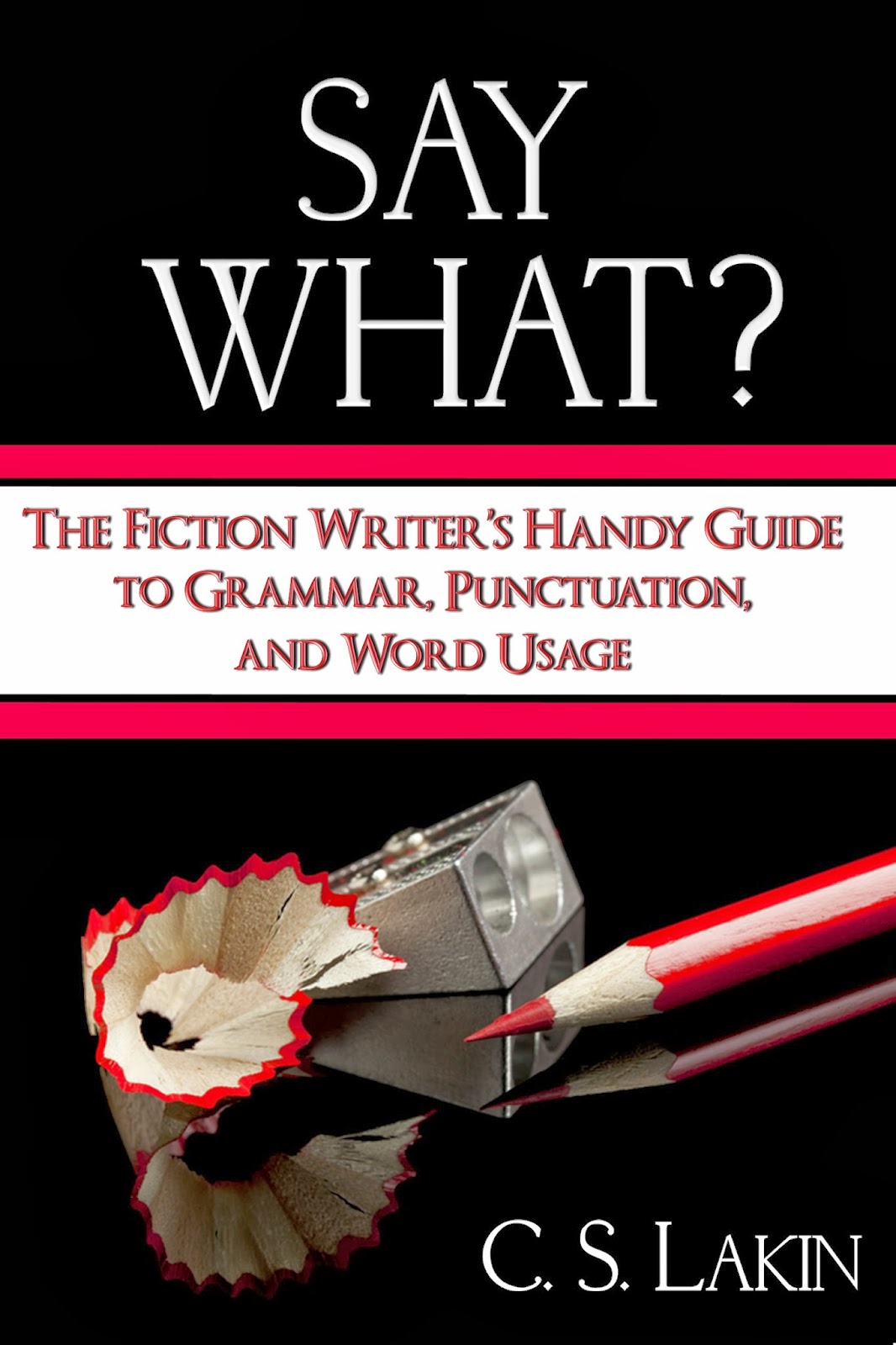
on her award-winning blog Live Write Thrive. Her new book—Say What? The Fiction Writer’s Handy Guide
to Grammar, Punctuation, and Word Usage—is designed to help writers get a
painless grasp on grammar. You can buy it in print
here or as an ebook
here.
Now for the Give-Away part! We have a grammar question for you. The first person to answer correctly in the comments below will get a free book from C. S. Lakin! Be sure to put your email address in your comment as well so if you're the winner, we can contact you for your mailing address.
Question: How would you do a plural possessive for a family of people named Jones. Write a sentence talking about this family's car.